10 Over-the-Top Event Ideas That Actually Work (When Done Right)
There’s a time and place for minimalism. It creates clarity by removing noise and making space for the moment to land. Sometimes, minimalism misses the mark, and that is when you need an over-the-top impact. It’s not mindless excess or attention-seeking surface-level design. Real impact creates an experience guests do not easily forget.
When over-the-top ideas fail, they fail because everything is competing. These are the over-the-top ideas that actually work when they are executed correctly.
Fully Transformed Environment
If you only transform part of the venue, it feels like you decorated it. A full transformation feels immersive. This is the most effective way to remove any visual cues that guests are in a NYC venue. Everything from the ceiling to the walls and floor is hidden. There’s no sign of the ballroom or warehouse peaking through.
The drawback is that this level of transformation requires full commitment. You need the appropriate theme, budget, and vendors to pull it off successfully. When done well, guests aren’t just looking at the event; they are inside it.
One Oversized Design Element That Carries the Entire Room
Over-the-top design does not require multiple large elements. In many cases, one is enough. A single oversized installation placed intentionally can define the entire space. A large-scale sculpture, a suspended structure, or an architectural build that holds presence from every angle.
The key is restraint around it. Everything else supports that one decision. Lighting reinforces it. Layout directs attention toward it. The rest of the design steps back just enough to allow it to carry weight.
When multiple oversized elements compete, the space becomes overwhelming. When one dominates, the space feels powerful. Guests remember it because it was clear where to look.
Cinematic Layered Lighting
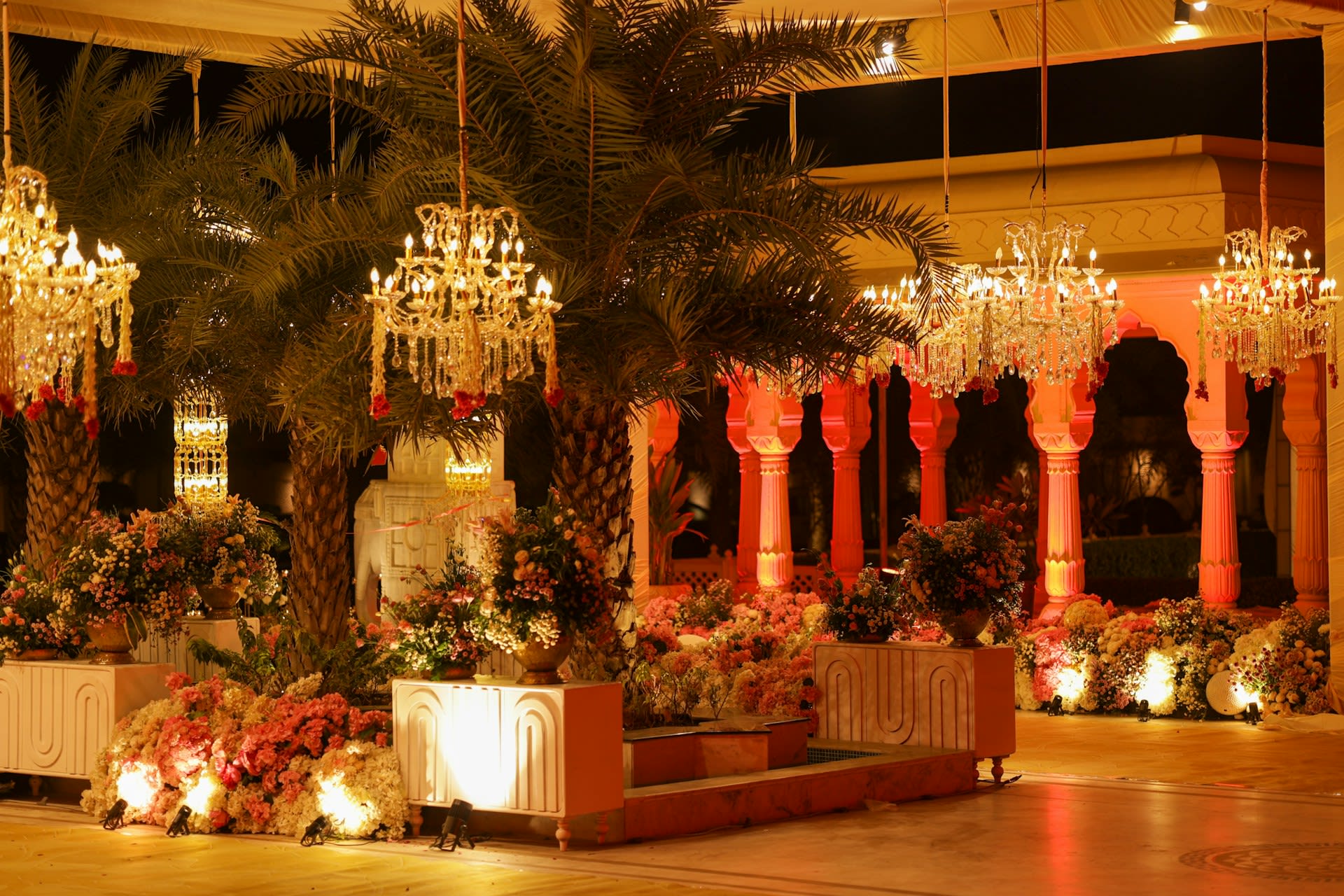
Basic lighting illuminates the entire room evenly. That’s boring and uninspired. Layered lighting creates depth and visual interest. The light helps build an immersive space. Take this a step further to create over-the-top lighting. Multiple layers of each type of lighting work together to create contrast and movement. Ambient, accent, and directional lighting shift throughout the space and change over the course of the event.
Dramatic Scale Changes
If you want to take the breath away from event guests, play with scale. Make some elements intentionally significantly larger or smaller than expected. Dramatically change and challenge how guests see the world around them.
Place oversized furniture around the space. Make tables extend far beyond the typical proportions. Arrange oversized flowers as arrangements. They make the environment feel different without needing additional decoration.
High-Intensity Entry Moments That Set Immediate Tone
While some events benefit from softer arrivals, over-the-top events often require the opposite. A strong, immediate entry moment.
Guests walk in and understand instantly that the event is operating at a different level. This might be achieved through lighting, sound, scale, or a combination of all three.
The key is clarity. The entry should not be confusing. It should not require explanation. It should land immediately.
When this is done correctly, it sets expectations for everything that follows. Guests adjust their behavior. Their energy shifts. Their attention increases.
Multi-Layered Installations That Reveal More Over Time
Over-the-top design does not have to be static. Some of the most effective environments reveal themselves gradually.
Installations that look one way from a distance and another up close. Elements that change as lighting shifts. Details that become visible as guests move through the space.
This creates depth. Guests continue to discover new aspects of the design throughout the event. It prevents the experience from feeling one-dimensional. Even in highly styled environments, there is still room for subtlety.
Dense, Immersive Decor That Still Maintains Direction
There are events where fullness is the goal. Layered tables. Rich textures. Multiple elements working together to create a dense visual experience. This can work, but only with hierarchy.
Even in the most detailed environments, guests need to know where to look. Primary focal points still exist. Secondary elements support them. Tertiary details fill in the background.
Without that structure, the space feels chaotic. With it, the density feels intentional. Guests experience richness without confusion.
Interactive Elements That Are Built Into the Design
Over-the-top events often include interaction. But when it is added as an afterthought, it feels disconnected. The most effective approach is to integrate interaction into the design itself.
Installations that guests can move through. Elements that respond to presence. Spaces that encourage participation without requiring instruction.
This keeps engagement natural. Guests do not feel like they are stepping out of the event to participate in something separate. They are already inside it.
Controlled Chaos That Still Feels Structured
There is a version of over-the-top design that feels chaotic. Multiple elements. High energy. Constant movement. This can work if it is controlled. Chaos without structure feels overwhelming. Chaos with structure feels exciting.
This means understanding where the intensity is placed and where it is not. Balancing high-energy areas with moments of restraint. Creating contrast so the environment does not feel exhausting. When done correctly, the event feels alive. Not scattered.
Strong Transitions Reinforce the Experience
When the event is large-scale, the transitions are even more critical. Guests will move from one space to the next. That movement needs to feel intentional, like an experience. It shouldn’t feel abrupt or disjointed.
Guests should feel like they are moving through a sequence, not between unrelated areas. Use lighting, material, furniture, and color to signal a progression.
The Risk of Getting It Wrong
If you don’t have a solid plan going into an over-the-top event, it’s going to end badly. There needs to be structure and control from the beginning. Top NYC event planners create a vision and a single goal for the event. Then, all decisions are guided by these. The result is less confusion for guests.

Learn More About Over-the-Top Event Ideas at The Event Planner Expo
Clients are asking for the right approach for the experience they are trying to create. Over-the-top design is not going away. The planners who understand this are not avoiding bold ideas. They are executing them at a higher level.
These conversations are already happening at The Event Planner Expo 2026, where the focus is not just on what looks impressive, but on what actually works in practice.
Reserve your booth at The Event Planner Expo 2026 and position your brand in front of event industry decision-makers.