Event Attendee Engagement Strategy: A Practical Guide
A room can be full while the event still feels empty. People sit quietly, skip the sponsor floor, and leave without a useful new connection. A strong event attendee engagement strategy prevents that outcome by giving every guest a clear reason to participate before, during, and after the event.
The best engagement plans do not begin with trendy technology. They begin with the attendee behaviors that support the event’s business goals. Every communication, session format, networking prompt, and activation can then reinforce those behaviors. Use this practical guide to connect the complete attendee journey.
Build your event attendee engagement strategy around outcomes
An effective event attendee engagement strategy defines the actions that create value for guests and organizers. It connects every interaction to a business outcome, measures meaningful participation instead of attendance alone, and uses an attendee journey map to remove friction from registration through follow-up.
Define the behaviors that matter
Begin with three to five specific behaviors you want to encourage. Avoid vague goals such as “make the event engaging.” Set measurable targets instead:
- First-time attendees complete their profiles before arrival.
- Every participant joins at least one small-group conversation.
- Decision-makers meet two relevant solution providers.
- Session attendees identify one action to apply after the event.
Connect each behavior to a clear business outcome. If the event is designed to strengthen a professional community, introductions and repeat participation may matter most. If the goal is education, workshop completion and post-event application may carry more weight. If sponsors need qualified conversations, relevance and consent matter more than raw booth traffic.
Map the attendee journey
Create a simple journey map covering registration, anticipation, arrival, sessions, networking, sponsor interactions, departure, and follow-up. For every stage, identify what the attendee needs, what action you want them to take, and what friction could stop them. This exercise reveals where one helpful prompt, host, or process change can improve the full experience.
For a deeper planning framework, review this guide to attendee journey mapping for conferences. Set a small scorecard before planning tactics. Useful measures include profile completion, poll responses, questions submitted, scheduled meetings, activation participation, connection requests, content downloads, and post-event community activity. Combine participation data with short qualitative feedback, because a high click count does not always signal a valuable experience.
How do you engage attendees before the event?
Engage attendees before an event by inviting them to influence the agenda, complete a useful profile, preview speakers, and request relevant introductions. Each pre-event touchpoint should help a guest prepare, contribute, or connect. This builds anticipation while giving planners the insight needed to personalize the experience.
Invite attendees to shape the agenda
Use a short preference survey during registration to learn which challenges, industries, and session formats matter most. Share selected results with speakers so they can address real audience priorities. A speaker might ask registrants to vote on two case studies, then build the winning scenario into a live workshop. This creates anticipation while improving relevance.
Keep requests easy to complete. Ask one useful question at a time, explain how the answer will improve the event, and show attendees that their input influenced the program. When people see their priorities reflected in the agenda, participation feels worthwhile rather than performative. These pre-event engagement strategies offer more ways to build useful anticipation.
Start introductions early
Encourage attendees to complete profiles that include what they can offer and who they hope to meet. Then provide optional matchmaking suggestions based on shared goals, complementary expertise, or similar challenges. A thoughtful suggestion such as “both of you are evaluating new event production partners” is more useful than an unexplained list of names.
Release useful previews in the weeks before the event. Short speaker previews, exhibitor spotlights, venue guidance, and networking prompts can build confidence. First-time attendees especially benefit from knowing what to expect, where to begin, and how to enter conversations. Keep the sequence focused so every message earns attention.
Design interactive sessions that earn participation
Interactive sessions earn participation when the activity helps attendees understand, practice, or apply an idea. Match each format to the subject, room, audience, and desired outcome. Give clear instructions, a time limit, and a useful deliverable so interaction feels purposeful rather than performative.
Choose the right participation format
| Format | Best use | Planner requirement |
|---|---|---|
| Live poll | Surface opinions or check understanding | Ask a focused question and discuss the result |
| Small-group exchange | Share experience and build connections | Provide prompts, timing, and a clear report-back |
| Workshop | Apply a framework or build a deliverable | Supply instructions, materials, and facilitation |
| Moderated Q&A | Address audience priorities | Collect, group, and prioritize questions |
Tell attendees why and how to participate. Instead of saying, “Discuss this at your table,” offer a specific prompt, a five-minute time limit, and a useful outcome. For example, ask each table to identify one obstacle, one solution, and one question for the speaker. Clear instructions reduce hesitation and create better contributions.
Build rhythm into the agenda
Alternate listening, reflection, conversation, and movement. Long presentation blocks make it difficult for attendees to sustain attention or process information. A short pause to compare notes with a neighbor can be more productive than an elaborate activity. Give facilitators permission to adapt if the room needs more time, clarification, or energy.
Design for different participation styles. Some attendees will readily speak in front of a room, while others prefer submitting a question digitally or discussing it in a small group. Providing multiple routes to contribute makes the event more inclusive and generates a wider range of insights.
Turn networking into a designed experience
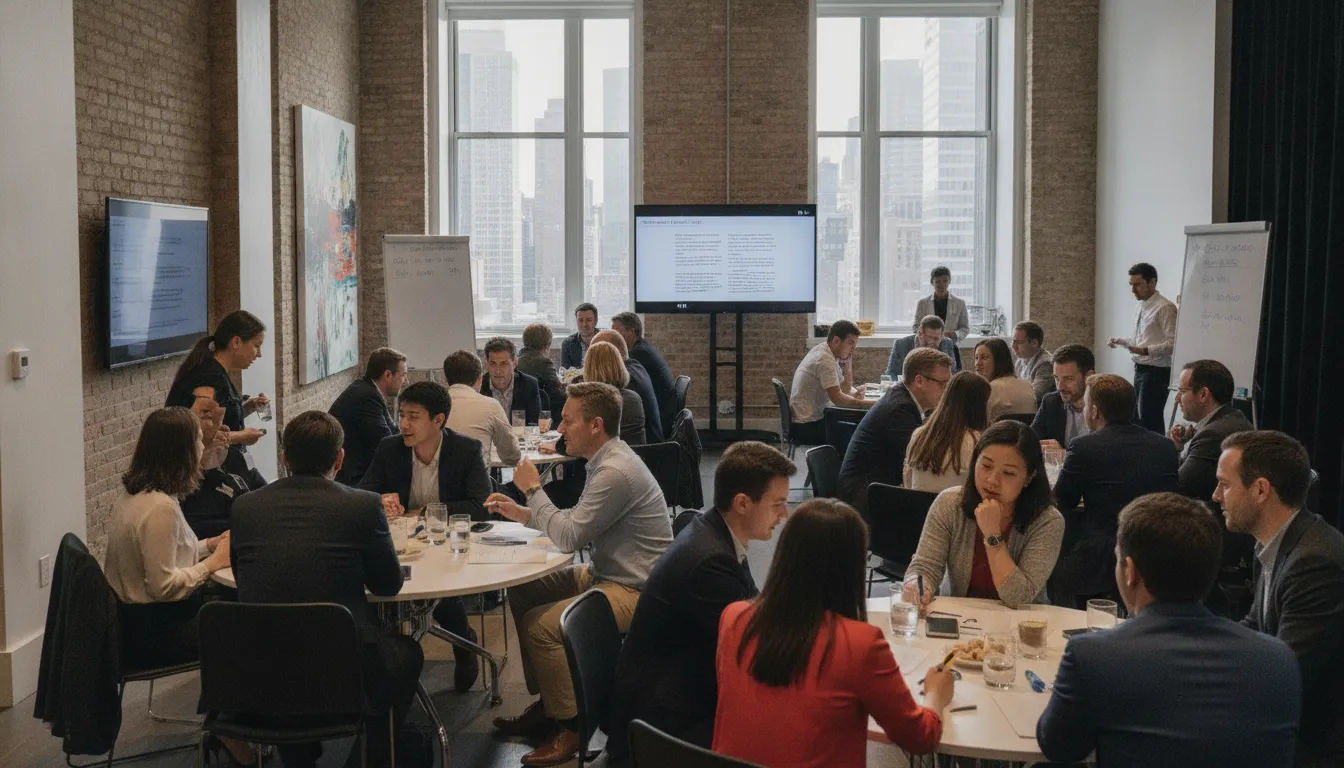
Designed networking gives attendees context, a conversation opening, and a reason to continue the relationship. Use curated groups, human hosts, focused prompts, and consent-based follow-up. This turns an intimidating reception into a productive environment where guests can meet people relevant to their goals.
- Identify connection goals. Ask what attendees want to learn, solve, offer, or find.
- Create relevant groups. Match people by complementary goals, not just identical job titles.
- Provide conversation prompts. Tie prompts to the event theme and real professional challenges.
- Add human hosts. Brief ambassadors to welcome guests and make thoughtful introductions.
- Make follow-up easy. Offer a consent-based way to exchange details and record next steps.
Use a mix of networking formats
Combine scheduled meetings with low-pressure opportunities. Curated roundtables work well for shared challenges. Hosted introductions help first-time attendees. Topic lounges make it easier to find relevant peers. Short peer exchanges can give every participant a starting point. Quiet areas also matter, since valuable conversations are difficult when people cannot hear one another.
Avoid measuring networking only by the number of connections made. Ask whether attendees met someone relevant and whether they expect to continue the conversation. Quality, consent, and usefulness should guide the design. For more ideas, explore these corporate event networking strategies.
Use onsite technology to remove participation friction
Onsite event technology should make a desired action easier, faster, or more useful. Choose tools only after defining the behavior they support. Test the full attendee flow under realistic venue conditions, provide a simple alternative, and assign staff who can solve common issues quickly.
Explore ticket options for The Event Planner Expo and experience engagement strategies in action.
Match tools to attendee needs
An event app can centralize schedules, profiles, messages, maps, and meeting requests. Live polling can help a speaker read the room. Digital Q&A can include attendees who are less comfortable approaching a microphone. Smart notifications can direct people to relevant opportunities. Badge scanning can simplify opt-in follow-up with exhibitors.
Each tool needs a clear purpose and an owner. If attendees are asked to download an app, give them an immediate benefit, such as building a personalized schedule or finding a recommended connection. Train staff to solve common issues quickly, and provide a simple alternative for attendees who cannot or do not want to use the technology.
Use data responsibly
Explain what information is collected, how it will be used, and when attendees are opting into contact. Do not treat a badge scan as permission for unlimited follow-up. Review participation data during the event to spot friction, but interpret it with context. Low activity may reflect a confusing interface, a schedule conflict, or an experience that is not relevant enough.
Create sponsor activations attendees choose to join
Sponsor activations earn attention when they give attendees useful insight, access, entertainment, or a solution to a real challenge. Align the sponsor’s goal with the attendee’s goal, make participation optional, and measure qualified conversations or next steps instead of raw foot traffic.
Design for mutual value
Brief sponsors on attendee priorities and the event’s engagement goals. Encourage them to build an activation around a real question or challenge. A technology partner might host a guided demonstration where attendees test a workflow. A venue partner might offer a compact design lab. A production expert might explain how a complex effect was created.
Make the invitation clear and participation optional. Planners looking for partners can explore the 2026 exhibitors to understand the range of event solutions represented at The Event Planner Expo. Brands interested in participating can also learn more about event opportunities.
Measure what happens after the activation
Agree on success measures before the event. Depending on the activation, these might include qualified conversations, demonstrations completed, meetings requested, resources shared, or attendee feedback. Give sponsors enough context to follow up thoughtfully. Relevant, consent-based follow-up protects the attendee experience and strengthens sponsor results.
How do you keep attendees engaged after the event?
Keep attendees engaged after an event by sending a focused recap, personalized resources, relevant introductions, and one clear next step. Invite participants to share an implementation lesson or join a targeted follow-up discussion. Then use their feedback to improve the next attendee journey.
Follow up with purpose
Within the first follow-up, remind attendees of the experience’s most useful moments and make the next action easy. Share a concise recap, selected resources, and a prompt to reconnect with someone they met. Segment communications when possible. Someone who joined a leadership roundtable should receive a different recommendation from someone who spent time exploring production partners.
Create opportunities for attendees to contribute after the event. Invite them to share an implementation lesson, answer a community question, or join a focused virtual discussion. Recognizing useful contributions encourages continued participation and gives the community fresh value.
Close the measurement loop
Compare results with the scorecard established at the beginning. Review which moments encouraged meaningful action and where attendees dropped off. Pair data with interviews or short open-ended questions. Ask what connection, idea, or experience proved most useful, and what made participation difficult.
Document the lessons while the team can still remember operational details. Preserve successful prompts, session structures, and activation principles. Then update the journey map for the next event. An event attendee engagement strategy improves when it becomes a repeatable planning discipline rather than a one-time collection of tactics.
Frequently asked questions
What is attendee engagement at an event?
Attendee engagement is the meaningful participation people have throughout an event journey. It includes actions such as shaping content, joining discussions, meeting relevant people, exploring useful solutions, and applying ideas after the event.
How do you measure event attendee engagement?
Measure behaviors linked to the event’s goals, such as profile completion, poll responses, questions, workshop participation, meetings, qualified sponsor conversations, and post-event activity. Combine these signals with qualitative feedback about relevance and value.
What makes an engagement activity effective?
An effective activity has a clear purpose, simple instructions, relevance to the audience, and an outcome participants value. It should make learning or connection easier rather than interrupting the experience.
When should attendee engagement begin?
Engagement should begin during registration and continue after the event. Early preference gathering and introductions improve relevance, while useful follow-up helps attendees apply ideas and sustain relationships.
Plan an experience attendees help create
A memorable corporate event is not something delivered to a passive room. It is an experience attendees help create through their questions, conversations, choices, and follow-through. Build every engagement tactic around a meaningful outcome, then remove the barriers that make participation difficult.
Learn more about The Event Planner Expo and start building an event experience that brings the industry’s most ambitious professionals and partners into the conversation.