8 Ways to Turn a Standard Ballroom Into a Fully Immersive Experience
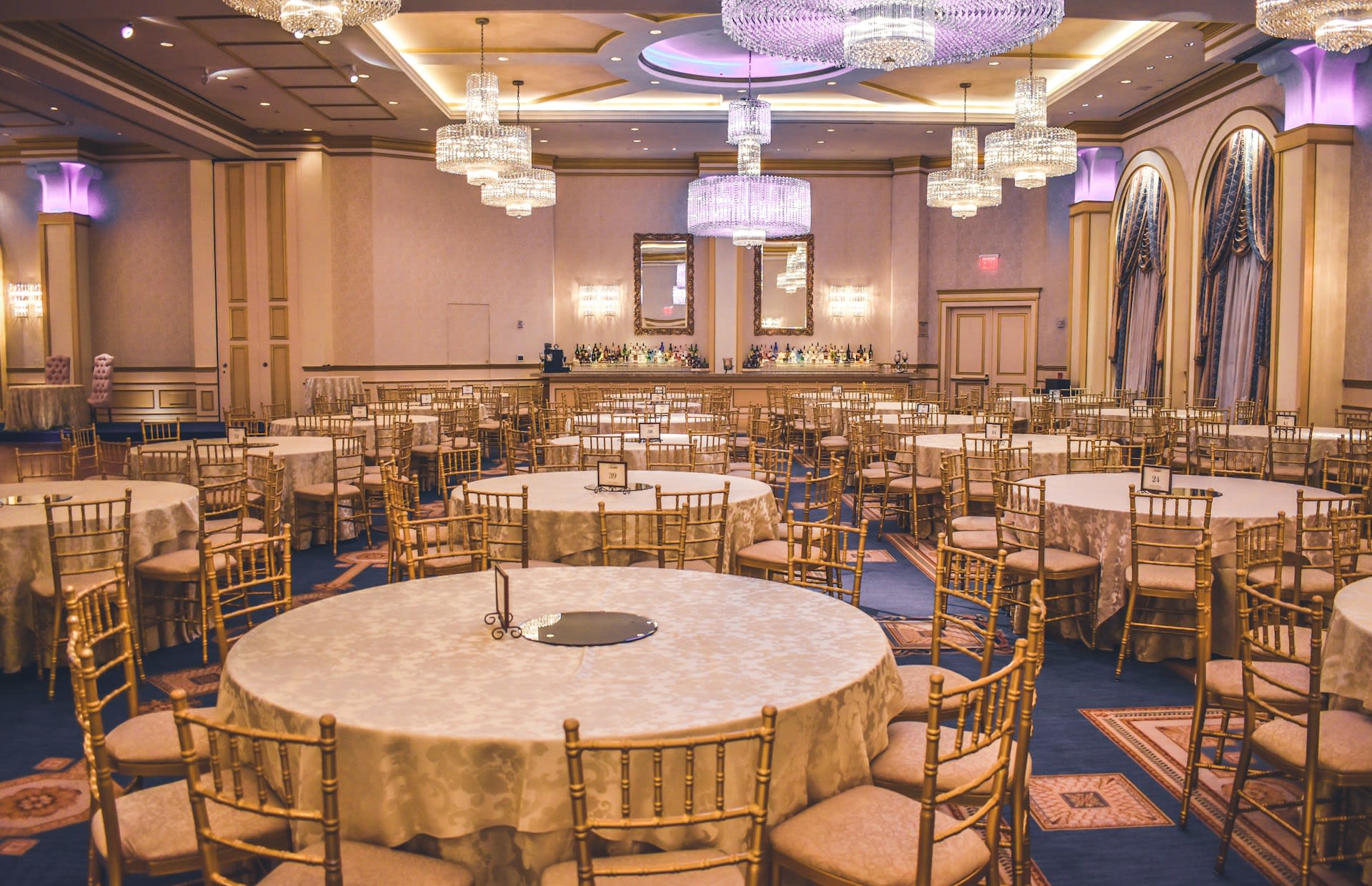
Ballrooms are designed to be neutral, which makes them flexible but also familiar. Guests recognize the ceilings, lighting, and layouts almost instantly, and that familiarity can lower the impact of an event. Immersive design changes that transform the space instead of simply decorating it. The goal is not to add more decor. It is to remove the venue as the focal point and create an environment that feels intentional, layered, and fully designed from the moment guests walk in.
Remove Visual Ballroom Anchors
The fastest and simplest way to break the fantasy is to leave parts of the ballroom exposed. We all recognize the hallmark patterns of hotel carpeting. Then there are the wall panels. The bland coloring of large-scale panels is designed to be moved as needed. What about air vents? You don't want to block them, but they are also obviously a ballroom element. Looking up, the ceiling grids can be a dead giveaway.
Guests aren't going to obviously point these elements out when walking through an event. They may not even consciously notice them. However, they see ballroom elements, and it draws them out of the fantasy. The illusion weakens, and the guest is a little less immersed.
The best way to prevent this from happening is to take a critical eye to the space. Walk through it and look for any visual anchors that scream "ballroom!". Then find ways to hide them. That doesn't mean covering everything. Sometimes, the carpet becomes unnoticed because there is a large ceiling installation that people are focused on.
Redesign the Ceiling
The ceiling is a dead giveaway in a ballroom. They all look the same. It's also one of the most commonly neglected areas by event planners. Guests spend more time looking up than most event planners realize. This creates a problem. As soon as a guest looks up, they remember where they are, and the illusion of the event is broken.
The easiest solution is to drape fabric. Completely transform and reshape the ceiling. Rigging can add structure and custom shaping. A suspended installation will draw the guests' eyes where you want them to look and away from where you don't. Darkness can "hide" the ceiling entirely. Focused and directional lighting brightens up the room below while darkening the ceiling area.
Use Lighting to Build Depth
The standard lighting used in a ballroom is designed for maximum visibility. It's great for a business conference. Not so good for an immersive event. Flat bright light loses depth and visual interest. Everything is bright, with no visual cues on what people should look at.
Adding different types of lighting in different strengths and colors creates contrast. There's a visual hierarchy.
Ambient lighting establishes the baseline. Accent lighting highlights focal points. Directional lighting creates movement and draws attention across the room. You can shift the environment throughout the event without physically changing anything.
Create Defined Zones
Ballrooms are typically one large, open space.
Immersion comes from breaking that up.
Not physically in a way that restricts movement, but visually in a way that creates variation.
A lounge area should feel different from a dining area. A bar should feel different from a stage. Each zone should have its own identity while still connecting to the overall design.
This can be achieved through lighting, materials, layout, and subtle structural elements.
A change in flooring can signal a shift. A variation in lighting intensity can define a boundary. A different seating style can create a new experience within the same room.
Guests should feel like they are moving between environments, not just across a single space.
That variation creates engagement.
It gives the room rhythm.
Control Entry and Reveal
Most ballroom events reveal the entire space immediately.
Doors open. Guests walk in. Everything is visible.
That removes anticipation.
Immersive environments control the reveal.
Guests should not see everything at once.
Entry paths can be adjusted so the space unfolds gradually. Lighting can limit visibility so certain areas are revealed later. Transitional spaces can create a pause before the main room is fully introduced.
Even a slight delay in full visibility changes perception.
It builds curiosity.
And curiosity keeps guests engaged before the event even begins.
The reveal becomes part of the experience.
Integrate Sound
Immersion is not only visual.
Sound plays a critical role in how a space feels.
Ballrooms often rely on neutral or inconsistent audio. Background music that does not match the environment. Sound that is either too quiet or poorly distributed.
Immersive environments treat sound as a design element.
Music should align with the tone of the event. Audio should be balanced so it fills the space evenly. Transitions in sound should match transitions in the event.
Even subtle adjustments can make a difference.
A shift in music as guests move between zones. A change in volume as the event progresses. Sound cues that align with key moments.
Guests may not consciously notice these changes.
But they feel them.
And that feeling reinforces immersion.
Build One Central Element
Immersion needs structure.
Without it, the environment can feel scattered, even if it is visually strong.
A central element provides that structure.
This could be a stage, a large-scale installation, or a design feature that anchors the entire room.
Everything else connects to it.
Lighting directs attention toward it. Layout flows around it. Secondary elements support it.
This creates cohesion.
Guests always have a reference point, even as they move through different zones.
And that consistency keeps the experience from feeling disjointed.
Transitions Maintain the Illusion
Immersion is a delicate balance. To complete the experience, the experience needs to extend beyond the main ballroom. Top event planners know the guests move about the entire space. With this in mind, they consider the hallway outside the ballroom, bathrooms, and entry points. These adjacent spaces are perfect transition areas. Lighting continuity can carry the design beyond the main room. Material choices can extend the visual language. Sound can bridge the gap between spaces.

Learn More About Creating an Immersive Experience at The Event Planner Expo
Turning a ballroom into an immersive experience is about consistency and control. While having a large budget is helpful, it's not required. Skilled NYC event planners know how to transform a space into an immersive experience. They know when to hide and when to emphasize.
Conversations about immersive design are already happening at The Event Planner Expo 2026. The focus is not just on how events look, but how they are experienced. Because the goal is not to decorate a ballroom. It is to remove it entirely from the guest’s perception. That is what makes immersion work.
Secure your place on The Expo floor and connect with industry leaders. Reserve your booth today.