7 Ways to Make a Basic Venue Look Completely Custom
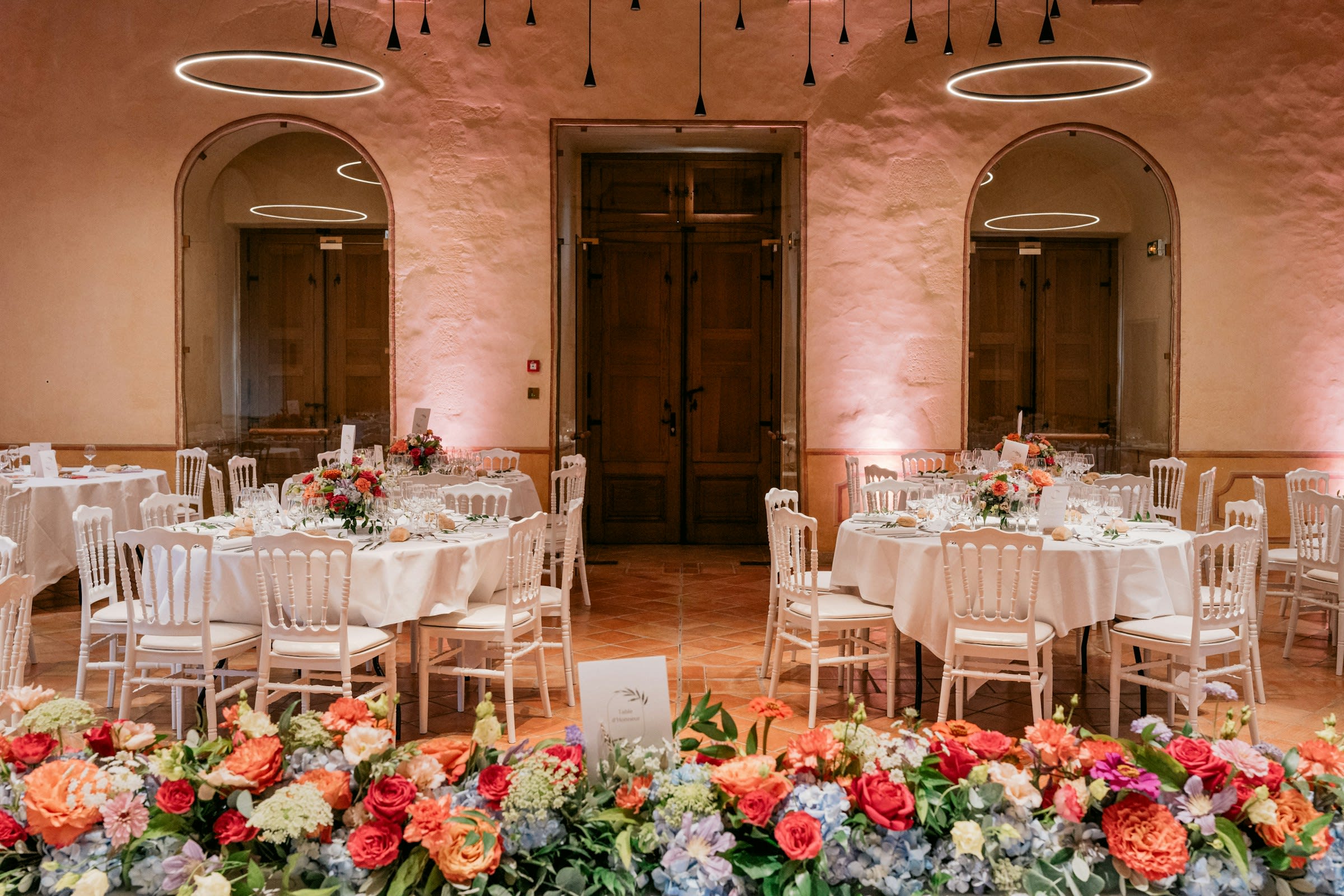
Most venues are designed to stay neutral, which makes them flexible but often forgettable. What makes a space feel basic is rarely the venue itself. It is the predictable layouts, standard lighting, and decor that feels added instead of integrated. Clients are pushing back on that approach. They want spaces that feel tailored to their event, not simply dressed up for it. That kind of transformation comes from treating the venue as a foundation, controlling how guests experience the space, and designing with intention from the moment they arrive. These are the strategies planners use to make neutral venues feel completely custom.
Redefine the Ceiling Instead of Ignoring It
Ceilings are one of the most overlooked elements in event design.
They are also one of the most defining.
A standard ballroom ceiling immediately signals a standard event. Grid lines, recessed lighting, exposed fixtures. These details are familiar, and familiarity reduces impact.
Custom environments address the ceiling directly.
This can be done through draping, rigging, suspended installations, or lighting treatments that visually reshape the space.
Lowering the ceiling slightly can make a large room feel more intimate. Adding structure overhead can create direction and draw the eye upward in a controlled way. Even using darkness strategically can cause the ceiling to disappear entirely.
Lighting Removes the Venue’s Default Identity
Lighting has the ability to override almost everything else.
Wall color. Material inconsistencies. Architectural details.
Basic venues often rely on overhead lighting that flattens the space and exposes every default feature.
Custom environments remove that completely.
Instead of lighting the room evenly, lighting is used to redefine it.
Focused pools of light create zones. Shadows hide what does not need to be seen. Directional lighting pulls attention exactly where it should go.
Color temperature also plays a role. Warmer tones create softness. Cooler tones create contrast. Subtle shifts throughout the event can change how the entire space feels without physically altering anything.
The venue’s original identity fades.
What remains is the environment you create.
Lighting is not an addition.
It is a replacement for how the space is experienced.
Change the Layout So It No Longer Feels Familiar
Guests recognize layouts immediately.
They know what a ballroom setup looks like. They expect certain placements. They move through the space based on previous experiences.
Customization disrupts that.
Tables are repositioned in ways that feel less predictable. Bars are placed where they shift circulation instead of following standard placement. Entrances and focal points are reoriented.
The goal is not confusion.
It is removal of familiarity.
When guests cannot immediately map the space based on memory, it feels new.
Even if the venue itself has not changed structurally, the experience of it has.
Layout is one of the most powerful tools for transformation because it directly impacts behavior.
It changes how people move, where they gather, and how they interact with the environment.
And it does so without requiring additional budget.
Control Sightlines So Guests Only See What You Want Them To
Customization is not about changing everything.
It is about controlling perception.
Guests experience a space based on what they can see from where they stand.
If certain areas of the venue do not align with the design, they do not need to be removed entirely.
They need to be hidden.
This can be done through draping, partitions, lighting, or strategic placement of design elements.
A well-placed structure can block an undesirable view. Lighting can push attention away from areas that do not need focus. Layout can naturally guide guests so they never face certain directions.
When sightlines are controlled, the environment feels cohesive.
Guests do not question what is outside of their view.
They engage fully with what is in front of them.
Use Materials That Shift the Perception of Quality
Venue materials often feel basic. That doesn't mean they are bad. They were chosen for their durability as an investment. While they were a smart choice for the venue, they may not work well with an event's design theme. They also may not signal quality.
The right flooring can transform a space, making it feel more intimate or more open. Fabrics can turn a boring venue into one that feels luxurious and elevated. Custom surfaces create unique elements in the avenue that guests have been in hundreds of times before.
Create Transitions That Separate the Event From the Venue
NYC is famous for its hustle and bustle. The people living in the city are accustomed to a fast-paced lifestyle that just doesn't quit. Give them something to experience by separating them mentally from the energy found on the street. Creative event planners begin the event experience before guests ever set foot through the venue doors. The experience starts at the entry points, in the hallways, and in other pre-function areas.
Try having a dark entry point that cuts off the city lights on the street, which transitions to the event lights. Narrow the entry to create a more intimate experience that funnels guests into the venue, which opens into a larger space. Change the flooring so it transitions as guests cross the venue's threshold.
The Difference Between Decorated and Designed
There's a clear and significant difference between merely decorating a venue and designing it. Top NYC event planners know how to design. They have an eye for the visual and the experiential. Decor just sits on top of what is already there. There's no real connection or cohesion. Design integrates into the existing venue. It changes how the space functions.
Clients are starting to understand this difference. They want a venue that they can exist in. This means going beyond just putting more "stuff" in the room. Event planners have to feel the venue and design it from the ground up.

Learn More About Making a Venue Look Custom at The Event Planner Expo
Customization is about control. The planners who do this well are not always adding more. They are editing, controlling, and thinking about the space.
At The Event Planner Expo 2026, the focus is on making them function differently. Because the goal is not to decorate a venue. It is to remove it from the experience entirely. That is what makes a basic venue feel completely custom. And that is what clients are starting to expect at a higher level.
Ready to showcase your products and services? Reserve your booth at The Event Planner Expo 2026.