7 Best Floral Designs in Events Right Now
Stop using florals to fill empty visual space. Stop using them to signal luxury or elegance. It’s time to use florals intentionally to support mood and moments. The shift in your approach will be immediately noticeable. It makes florals feel like a premium element instead of just an expensive one.
1. Grounded Installations Anchor the Room
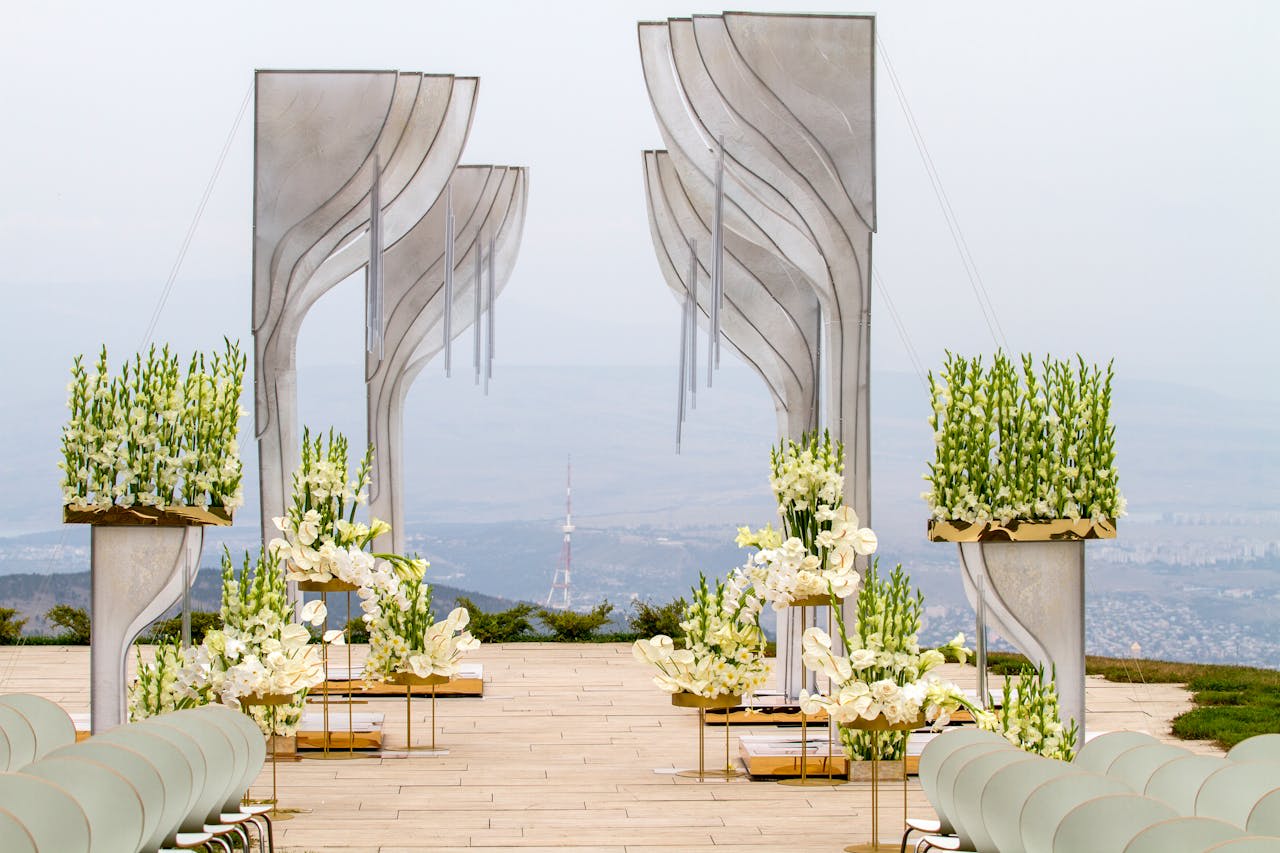
The trend of overhead foral installations had its moment. It’s time to move on. Grounded florals are now having their moment. Think large-scale arrangements that start on the floor and extend up.
This approach creates a stronger visual anchor. It also gives them functionality. Place them at transition points, entrances, or focal points. These installations are more connected to the room, not just random clumps floating in the space above.
In NYC venues where ceiling restrictions and rigging limitations are common, grounded florals are also more practical. They also reduce production complexity.
2. Elevated Monochromatic Palettes
Multi-toned color palettes are beautiful, but monochromatic palettes can create a much more visually stunning effect. However, it has to be done correctly, or the effect literally falls flat. Top event planners know how to weave textures and shades together when using a single color.
The effect is an event venue that feels elevated and luxurious, but also restrained. The visual noise is turned down, allowing guests' attention to focus where you want it.
Florals are a perfect decor element to accomplish this. Florals naturally come in a variety of shades and have plenty of texture.
3. Sculptural Florals Are Design Elements
Florals are becoming more architectural.
Less about fullness.
More about form.
Branches, negative space, and directional shapes are being used to create movement within arrangements.
These designs feel intentional from every angle.
They guide the eye.
They support the layout.
They reinforce the structure of the space.
This approach works particularly well in modern NYC venues where clean lines and minimal architecture require design elements that can hold their own.
Sculptural florals do that without adding clutter.
They also evolve better throughout the event.
Dense arrangements can collapse visually over time. Sculptural designs maintain their structure longer, especially in environments with changing temperatures or extended programming.
This consistency matters more than most planners account for.
4. Low & Dense Centerpieces
Tall centerpieces are losing ground in many formats.
They create visual impact, but they interrupt interaction.
Low, dense arrangements are taking their place.
They keep sightlines open.
They allow guests to engage without obstruction.
They feel more intimate.
This is especially relevant for corporate and networking-focused events where conversation is the priority.
In NYC, where tables are often closer together due to space constraints, this shift improves both function and flow.
The room feels more connected.
Guests are not working around the design.
They are settling into it.
That subtle difference increases dwell time and improves the overall energy of the room.
It also makes transitions smoother.
Guests are already engaged with each other, which makes it easier to move into programming without forcing attention.
5. Moments Over Saturation
More is more. It isn’t always better. Stop spreading florals out to cover every inch of the venue. It’s overdone and sloppy. Instead, focus them into one strong entrance moment. Or you can arrange them all around the stage for an obvious focal point.
Keep the rest of the room intentionally bare. It creates intentional contrast. The arranged florals are given space and attention to actually land with guests. The impact isn’t lost, allowing for budget efficiency without feeling like a reduction.
6. Integrate Florals
Tabletop centerpieces are overdone and boring. They statically sit there, blocking people’s view and not adding anything to the venue’s layout. Today’s top event planners are taking a new approach that focuses on integration.
Wrap the florals around the bar. Weave them throughout the lounge area furniture. Layer them on shelving or throughout architectural features. Look for ways you can integrate florals into the event’s layout and design.
Have guests move through the florals instead of around them. In NYC, where venues can be tight, it creates better flow. It also feels more cohesive.
7. Seasonal, Local, and Slightly Imperfect Designs
There has been a noticeable shift away from perfectly manicured designs. The overly polished look tends to feel stiff and unapproachable. So it’s time to let go of perfect symmetry, overly packed arrangements, and sculpted shapes.
Clients and guests are loving a more natural approach. Use seasonal blooms. Source from local florists. Embrace imperfection and variation.
This doesn’t mean being sloppy or unrefined. There needs to be an intentional approach. The arrangements will feel more authentic. It’s less manufactured for a softer experience.

Learn More About Floral Designs at The Event Planner Expo
Don’t expect to see florals disappear from events any time soon. They are just becoming more strategic. It’s less about an overwhelming amount and more about placement and integrations. If your floral plan still starts with how many arrangements you need, you are approaching it from the wrong angle.
If it starts with where florals will have the most impact, you are aligned with where 2026 is going. You are thinking about event production moving into 2026. The Event Planner Expo 2026 is where these design strategies are being pushed further.
Reserve your booth for The Event Planner Expo 2026 and see how top NYC planners are using floral design to support structure, not just style.